




Prague is a compact, walkable capital where most first-time visitors need 3 to 4 days: two for the castle district, Charles Bridge and the Old Town, one for the Jewish Quarter and the viewpoints, and an optional fourth for a day trip to Kutná Hora. This guide covers the 10 places worth your time, what each one is like, what it costs in 2026, where to stay and how to get around.
This guide contains affiliate links. If you book through them, we may earn a small commission at no extra cost to you.
Why Visit Prague?
Prague grew up on both banks of the Vltava River, with a castle on one hill, a fortress on another and a medieval town in between. It was the seat of Holy Roman Emperor Charles IV in the 14th century, and because it escaped heavy bombing in the 20th century, the center still reads like an architecture textbook, from Romanesque cellars to Art Nouveau cafés. The city is known for:
- Prague Castle: one of the largest castle complexes in the world, with St. Vitus Cathedral at its heart.
- Charles Bridge: a 14th-century stone bridge lined with Baroque statues, the most famous walk in the city.
- The Astronomical Clock: a medieval clock on the Old Town Hall where the twelve apostles appear every hour.
- Jewish heritage: the synagogues and Old Jewish Cemetery of Josefov, one of the best-preserved Jewish quarters in Europe.
- Beer: Czechs drink more beer per person than almost anyone, and pub culture is part of daily life.
Is Prague Right for You?
| Type of trip | How Prague fits |
|---|---|
| History and culture | Excellent: a UNESCO-listed center, a huge castle complex, Jewish heritage and museums on every street. |
| Couples and romantic trips | Excellent: Charles Bridge at dawn, river cruises, classical concerts in Baroque churches and views from Petřín Hill. |
| Families with kids | Good: the funicular, the mirror maze, trams and free public transport for children under 15. Cobblestones are hard on strollers. |
| Budget travelers | Very good: cheap public transport, free viewpoints and churches, and lunch menus at around CZK 200. |
| Nightlife | Very good: pubs, cocktail bars and clubs, though the Old Town gets rowdy on weekend nights. |
| Travelers with limited mobility | Mixed: the Old Town is flat-ish, but the castle hill and Petřín are steep. Use trams 22 and 23 to reach the castle from above. |
Prague Quick Facts
| Best time to visit | May–June and September: mild weather and fewer crowds than July–August. December is busy but magical with Christmas markets. |
|---|---|
| How many days | 3–4 days, including one day trip. |
| From the airport | Trolleybus 59 to Nádraží Veleslavín, then metro line A: a 90-minute ticket costs CZK 46 in the PID Lítačka app or CZK 50 on paper. The Airport Express bus to the main station costs CZK 200. |
| Getting around | 24-hour ticket: CZK 140 in the app, CZK 150 on paper. 72-hour ticket: CZK 340 / CZK 350. Children under 15 and adults over 65 ride free. |
| Tourist tax | CZK 50 per person per night, added to your hotel bill. |
| Currency | Czech koruna (CZK), not the euro. About CZK 22 = $1 in November 2026. Cards are accepted almost everywhere. |
Know Before You Go
Is Prague a walkable city?
Yes. The Old Town, the Jewish Quarter, Charles Bridge and Malá Strana are all within a 20-minute walk of each other, and most visitors walk everywhere in the center. The exceptions are the hills: Prague Castle, Strahov and Petřín sit well above the river. Take tram 22 or 23 up to the Pražský hrad or Pohořelec stops and walk down through the castle and Malá Strana instead of climbing. Streets are paved with small granite cobbles, so wear comfortable shoes.
Is Prague safe?
Prague is one of the safer capitals in Europe, and Czechia ranks 13th of 163 countries in the 2026 Global Peace Index. Violent crime against visitors is rare; the real issue is petty theft. Pickpockets work Charles Bridge, the crowd in front of the Astronomical Clock, Wenceslas Square and busy trams such as line 22. Avoid street money changers, and when a card terminal or ATM offers to charge you in dollars, choose koruna instead. The emergency number is 112.
Does Prague have Uber?
Yes. Uber, Bolt and the local app Liftago all work in Prague and show the price before you ride. At the airport, Uber Airport is the official taxi service. Since October 1, 2026, Prague no longer caps metered taxi fares, so hailing a cab on the street is a gamble: use an app with an upfront price instead.
How do you get around Prague?
The integrated PID network covers three metro lines, an extensive tram network, buses, ferries and the Petřín funicular, all on one ticket. Buy tickets in the PID Lítačka app (cheaper) or from machines and newsstands, and validate paper tickets when you first board. Inspectors check often and wear plain clothes. Trams are the most scenic way to move around, and night trams run after the metro closes.
Map of the Best Places to Visit in Prague
The numbers on the map match the list below. All ten places are inside the city and reachable by tram or metro.
10 Best Places to Visit in Prague
1. Prague Castle and St. Vitus Cathedral

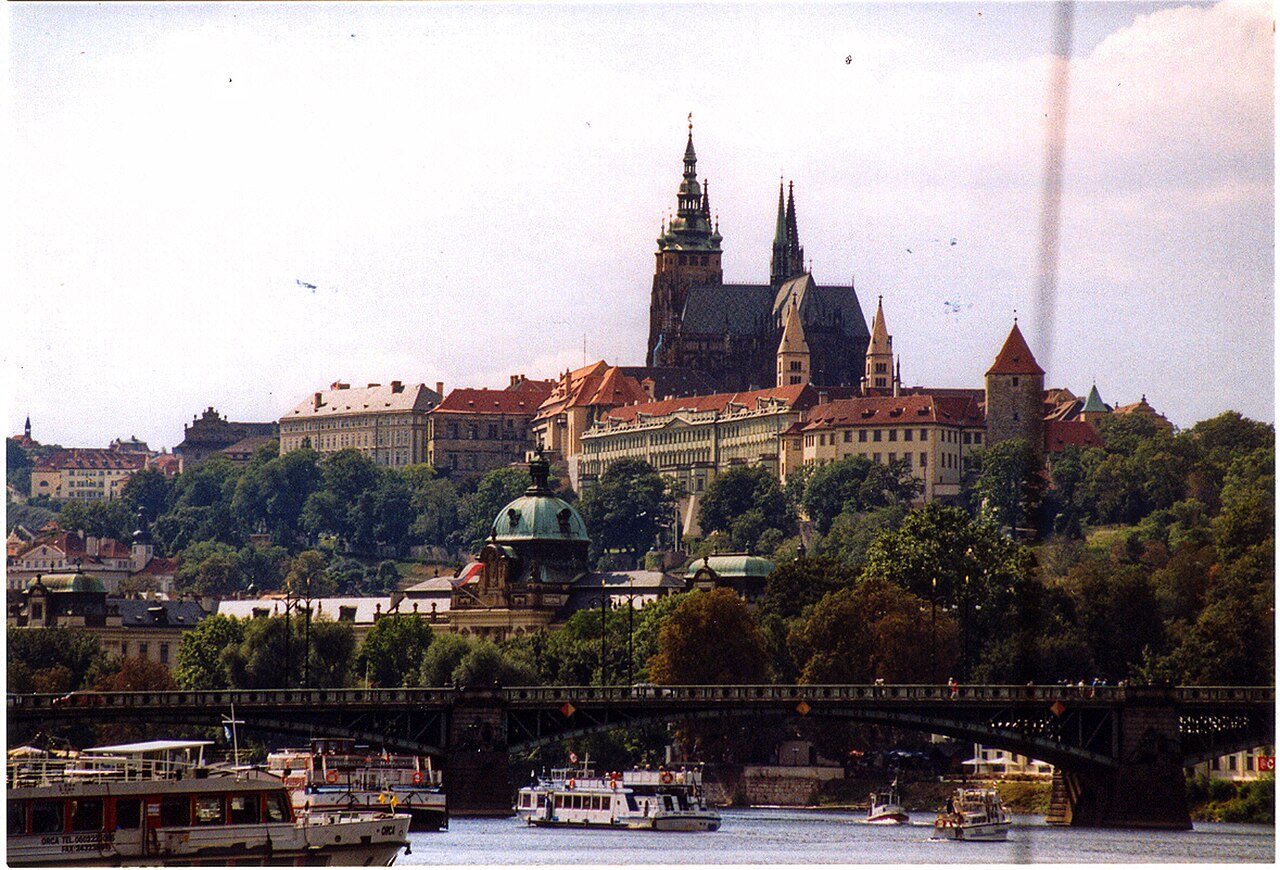
Prague Castle has been the seat of Czech rulers for more than a thousand years, and today it is still the office of the president. It is less a single castle than a walled district of palaces, churches, courtyards and gardens stretched along a ridge above the river. The grounds and courtyards are free to enter from 6 a.m. to 10 p.m., and at noon the guards change at the main gate with a short ceremony.
The centerpiece is St. Vitus Cathedral, begun in 1344 under Charles IV and only completed in 1929. Inside you will find the Chapel of St. Wenceslas, walled with semi-precious stones, a stained-glass window by Alfons Mucha and the silver tomb of St. John of Nepomuk. The main circuit ticket also covers the Gothic Vladislav Hall in the Old Royal Palace, the Romanesque St. George’s Basilica and Golden Lane, a row of tiny colorful houses built into the castle wall.
Why we recommend it: no other place tells Czech history as completely, and the view from the castle ramparts over the red roofs of Malá Strana is the classic Prague panorama.
Area: Hradčany · Price: main circuit CZK 450 adults (about $20), valid for two days; cathedral tower CZK 200 extra · Hours: interiors 9 a.m.–4 p.m. (November–March), 9 a.m.–5 p.m. (April–October) · Time needed: 3 hours
Tip: Arrive at 9 a.m. and go straight to the cathedral before the tour groups. Take tram 22 or 23 to the Pražský hrad stop so you start at the top and walk downhill to Malá Strana.
See Prague Castle tickets and guided tours
2. Charles Bridge
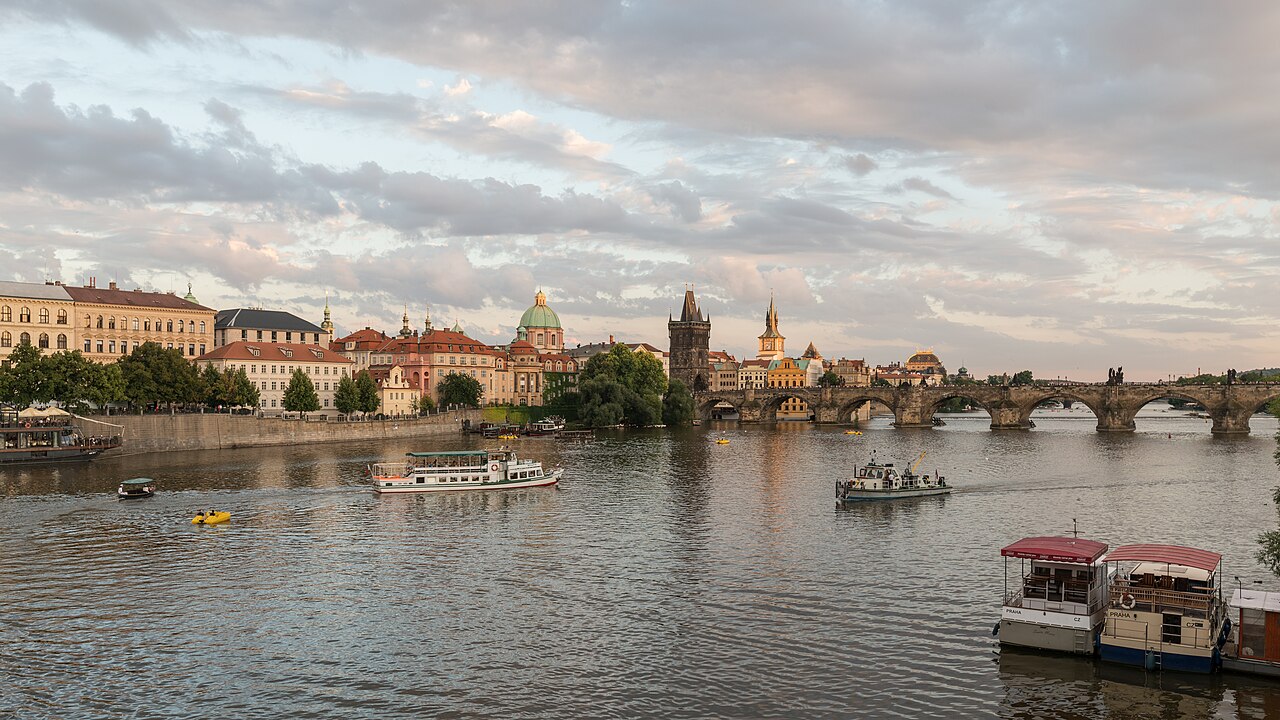
For more than four centuries, Charles Bridge was the only bridge across the Vltava in Prague. Construction began in 1357 under Charles IV, and the result is a 500-meter stone bridge with a Gothic tower at each end. The 30 Baroque statues along the parapets were added from around 1700 onward; most are now copies, with the originals kept in the Lapidarium of the National Museum.
By late morning the bridge turns into a slow-moving crowd of visitors, painters and musicians. The most famous statue is St. John of Nepomuk, thrown into the river from this bridge in 1393: touching the bronze plaque below him is said to bring good luck and a return to Prague, which is why it is polished to a shine.
Why we recommend it: it links the two halves of historic Prague and frames the castle like nothing else. At sunrise you can have it almost to yourself.
Area: between the Old Town and Malá Strana · Price: free; Old Town Bridge Tower CZK 250 adults · Best time: before 8 a.m. or after dark
Tip: Climb the Old Town Bridge Tower for the best view along the bridge to the castle. Go in the first hour after opening, when Prague City Tourism’s Early Bird discount halves the ticket price.
3. Old Town Square and the Astronomical Clock

Old Town Square (Staroměstské náměstí) has been Prague’s main marketplace since the 12th century. Around it stand the twin Gothic spires of the Týn Church, the pink-and-white Baroque Kinský Palace, the white St. Nicholas Church and, in the middle, the memorial to the reformer Jan Hus, burned at the stake in 1415.
On the corner of the Old Town Hall hangs the Astronomical Clock (orloj), first installed in 1410 and one of the oldest working astronomical clocks in the world. Every hour from 8 a.m. to 11 p.m., the twelve apostles parade past two small windows while a skeleton rings a bell. The show lasts under a minute, so many visitors are underwhelmed. The real reward is the town hall tower: an elevator and a gentle ramp lead to a gallery with a 360-degree view over the square’s rooftops.
Why we recommend it: it is the historic heart of the city, and the tower view is one of the best in Prague without a climb.
Area: Old Town · Price: square free; Old Town Hall tower CZK 350 adults, 50% off in the first hour after opening · Hours: 9 a.m.–8 p.m. (April–December), 10 a.m.–7 p.m. (January–March)
Tip: Watch the clock show once, then step back from the crowd: this is pickpocket central. Interior tours of the town hall, its chapel and Romanesque cellars cost a small surcharge paid on the spot.
4. Jewish Quarter (Josefov)

For centuries, Prague’s Jews lived in a walled ghetto just north of the Old Town Square. Most of it was demolished around 1900 and replaced with elegant apartment buildings, but six synagogues, the Jewish Town Hall and the Old Jewish Cemetery survived. Today they form the Jewish Museum in Prague, which holds one of the largest collections of Jewish art and artifacts in the world.
One ticket covers the Maisel, Pinkas, Klausen and Spanish synagogues, the Ceremonial Hall and the Old Jewish Cemetery, where some 12,000 tombstones lean against each other in layers. The walls of the Pinkas Synagogue are hand-painted with the names of nearly 80,000 Czech and Moravian Jews murdered in the Holocaust, and the Spanish Synagogue dazzles with a gilded Moorish-style interior. The Old-New Synagogue, still in use and the oldest active synagogue in Europe, needs a separate ticket.
Why we recommend it: it is moving, beautifully presented and essential to understanding the city’s history.
Area: Josefov · Price: CZK 600 adults, valid for 3 opening days · Hours: 9 a.m.–4:30 p.m. (late October–March), 9 a.m.–6 p.m. or 7 p.m. in spring and summer · Closed: Saturdays and Jewish holidays · Time needed: 2–3 hours
Tip: Arrive right at 9 a.m., ideally on a Sunday or Monday morning, and visit the Pinkas Synagogue and cemetery first, before the groups. Bags go through a security check.
Compare Jewish Quarter tours and tickets
Local tip – the Saturday trap: every site of the Jewish Museum and the Old-New Synagogue is closed on Saturdays (Shabbat) and on Jewish holidays. If your trip runs Friday to Sunday, book Josefov for Friday or Sunday morning and save Saturday for the castle, Petřín and Vyšehrad.
5. Malá Strana and St. Nicholas Church

Malá Strana (the Lesser Town) spreads below the castle on the west bank of the river. It was rebuilt by aristocrats in the 17th and 18th centuries, and its streets are lined with Baroque palaces, embassies, hidden gardens and old house signs instead of numbers. Walk down Nerudova Street from the castle, then lose yourself in the lanes around Kampa Island and the Lennon Wall.
The square is dominated by St. Nicholas Church, the finest Baroque church in Prague, with its green dome, a ceiling fresco covering some 1,500 square meters and an organ once played by Mozart. In the evenings it hosts classical concerts.
Why we recommend it: it is the most atmospheric neighborhood in the city, and quieter than the Old Town once you step off the main route to Charles Bridge.
Area: Malá Strana · Price: St. Nicholas Church CZK 150 adults · Hours: church 9 a.m.–4 p.m. in winter · Time needed: half a day with Kampa
Tip: St. Nicholas does not accept the Prague Visitor Pass or other city cards, so bring a card or cash in koruna.
6. Petřín Hill and Lookout Tower

Petřín is the green hill above Malá Strana, covered with orchards, rose gardens and walking paths. At the top stands the Petřín Lookout Tower, built for the 1891 Jubilee Exhibition as a loose 1:5 copy of the Eiffel Tower. Climb its 299 steps (or pay extra for the elevator) for a view across the whole city, and on clear days far into Bohemia. Next door is a 19th-century mirror maze that kids love.
The easiest way up is the Petřín funicular from Újezd. After two years of reconstruction it reopened on September 22, 2026, with new glass-heavy cars.
Why we recommend it: it is the best view of Prague Castle from the opposite side, and walking down through the orchards to Malá Strana is one of the city’s loveliest strolls.
Area: Malá Strana · Price: tower CZK 250 adults, elevator CZK 150 extra; funicular CZK 100 single (CZK 90 in the app), included in 24- and 72-hour tickets · Hours: tower 10 a.m.–6 p.m. (October–March), longer in summer
Tip: Ride the funicular with a 24-hour or 72-hour ticket and it costs nothing extra. Standard 30- and 90-minute tickets are not valid on it.
7. Strahov Monastery Library

Founded in 1143, the Premonstratensian monastery at Strahov sits at the top of the castle hill. Its library is one of the most beautiful in the world. The Theological Hall, from the 1670s, has a low stucco ceiling covered in frescoes and rows of antique globes; the taller Philosophical Hall from the 1790s rises two stories, with walnut shelves and a vast ceiling painting by Anton Maulbertsch.
To protect the books, visitors view both halls from the doorways rather than walking inside. The route also includes a cabinet of curiosities with stuffed sea creatures and other oddities collected by the monks.
Why we recommend it: it takes only 40 minutes, and the halls look exactly like an old library should. Combine it with the castle: Strahov is a 15-minute walk away along the ridge.
Area: Hradčany · Price: CZK 220 adults; library plus gallery CZK 390 · Hours: daily 9 a.m.–5 p.m., last entry 4:30 p.m. · Time needed: 40 minutes
Tip: The terrace beside the monastery has a sweeping view over the city and a monastic brewery nearby, a good place to stop for lunch.
8. Vyšehrad

Vyšehrad is a fortress on a rocky bluff above the river, about 3 km south of the center. Legend says it was the seat of Princess Libuše, who foresaw the founding of Prague. What you see today are 17th-century brick ramparts, the twin-spired Basilica of St. Peter and St. Paul and a peaceful park with views up the Vltava to the castle.
Next to the basilica lies Vyšehrad Cemetery, the resting place of Czech greats including the composers Antonín Dvořák and Bedřich Smetana and the painter Alfons Mucha. Its arcaded tombs are decorated with fine sculpture.
Why we recommend it: it is where locals go for a walk, it has a different view of the city and it is almost free of crowds, even in summer.
Area: Vyšehrad · Price: grounds and cemetery free · Getting there: metro line C to Vyšehrad, then a 10-minute walk · Time needed: 1.5 hours
Tip: Walk back to the center along the riverside embankment (Náplavka), where cafés and bars set up on moored boats.
9. Wenceslas Square and the National Museum

Wenceslas Square is less a square than a long, sloping boulevard, laid out as a horse market by Charles IV in 1348. It has been the stage for the biggest moments of modern Czech history: the 1918 declaration of independence, the protests against the Soviet invasion of 1968, the self-immolation of the student Jan Palach in 1969 and the Velvet Revolution of 1989, when hundreds of thousands gathered here to bring down communism.
At the top stands the statue of St. Wenceslas and behind it the neo-Renaissance National Museum, with a grand pantheon, natural history halls and a glass walkway to its modern annex. Along the square, look for Art Nouveau buildings such as the Hotel Evropa and the passages (pasáže) that run through the blocks.
Why we recommend it: it is where you understand 20th-century Prague, and the museum’s main staircase and dome are worth the ticket on their own.
Area: New Town · Price: square free; National Museum complex CZK 360 adults, free for children under 15 · Time needed: 2 hours with the museum
Tip: Duck into the Lucerna Passage to see David Černý’s sculpture of St. Wenceslas riding an upside-down horse, a witty reply to the statue outside.
10. Letná Park

Letná is a plateau on the north bank of the Vltava, directly across from the Old Town. Its edge offers the classic view of Prague’s bridges stacked one behind the other. The giant red Metronome at the top of the stairs stands on the site of what was once the largest statue of Stalin in the world, blown up in 1962. Today skateboarders gather around it.
Further along, the Letná beer garden spreads under chestnut trees with river views, and the park continues to the Hanavský Pavilion, a cast-iron Art Nouveau pavilion with a terrace overlooking the bridges.
Why we recommend it: it is free, it has one of the best views in the city and it shows you how locals spend a summer evening.
Area: Holešovice · Price: free · Best time: sunset, especially from spring to early fall
Tip: Climb up the steps from the Čechův most bridge at the end of Pařížská Street, and continue to the DOX contemporary art center or the Holešovice market if you have time.
Must-Do Experiences in Prague
Some of the best moments in Prague are not attractions with a ticket. These are the experiences we would not skip:
- Drink a tank beer in a proper pub. Order Pilsner Urquell from the tank at Lokál on Dlouhá Street, and learn the pours: hladinka (classic), šnyt (mostly foam) and mlíko (all foam, drunk in one go).
- Cross Charles Bridge at sunrise. Set an alarm once. The bridge, the statues and the castle in soft light without crowds are worth it.
- Hear classical music in a historic hall. The Rudolfinum, the Municipal House and churches like St. Nicholas host concerts most evenings.
- Eat Czech classics. Try svíčková (beef in cream sauce with dumplings), goulash and fried cheese, and skip the trdelník chimney cakes: they are a recent tourist import, not a Czech tradition.
- See the river from the water. A short cruise under Charles Bridge shows the city from its best angle, especially in the evening.
See Czech beer tasting tours in Prague
Where to Eat in Prague
| Place | Area | What to order | Good to know |
|---|---|---|---|
| Lokál Dlouhááá | Old Town | Tank Pilsner Urquell, svíčková, pork schnitzel | Long beer hall; popular, so book or arrive early in the evening |
| U Fleků | New Town | House dark lager, goulash | Brewing on site since 1499; touristy but historic |
| Café Louvre | New Town | Breakfast, Czech cakes, coffee | Grand café open since 1902, once frequented by Kafka and Einstein |
| Klášterní pivovar Strahov | Hradčany | Monastery beer, roast pork | Convenient lunch stop after the castle and Strahov Library |
| Any weekday lunch menu | Everywhere | Soup and main course (polední menu) | About CZK 200–220 in Prague, usually 11 a.m.–2 p.m. |
Tip: in pubs, bread, appetizers or a cover charge (couvert) may appear on the bill even if you did not order them. Check the bill, and say no when a waiter brings something you did not ask for. Tipping around 10% is normal for good service.
Should You Get a Prague Visitor Pass?
The Prague Visitor Pass is the official city pass from Prague City Tourism. It includes unlimited public transport (including the airport) and free entry to more than 70 attractions, among them the Prague Castle circuit, the Old Town Hall tower, the Jewish Museum and the Petřín Lookout Tower. It costs CZK 2,700 for 48 hours, CZK 3,300 for 72 hours and CZK 3,900 for 120 hours (adults).
We did the math for the itinerary in this guide, using 2026 adult prices:
| Plan | Paying separately | Visitor Pass | Verdict |
|---|---|---|---|
| 2 days: castle + Old Town + Josefov | CZK 1,930 (castle 450, Old Town Hall 350, Jewish Museum 600, Petřín tower 250, two 24h tickets 280) | CZK 2,700 (48h) | Not worth it: costs CZK 770 more |
| 3 days: the 10 places in this guide | CZK 2,240 (as above + Old Town Bridge Tower 250, with a 72h ticket at CZK 340 instead of day tickets) | CZK 3,300 (72h) | Not worth it: costs CZK 1,060 more |
| 3 days, sights-heavy | CZK 3,790 (as above + guided walking tour 600, hop-on tourist tram 350, St. Nicholas Bell Tower 200, Museum Kampa 400) | CZK 3,300 (72h) | Saves about CZK 490 |
Our verdict: for most first-time visitors the pass does not pay off, because Prague’s best experiences (Charles Bridge, the castle grounds, Vyšehrad, Letná) are free and public transport is cheap. It only makes sense if you plan to pack in many smaller paid sights and the included tours. With the Early Bird discount (50% off in the first hour at Prague City Tourism sites), paying separately gets even cheaper.
Check Prague Visitor Pass prices
Where to Stay in Prague
| Area | Best for | Pros | Cons |
|---|---|---|---|
| Old Town (Staré Město) | First-time visitors | Walk to almost everything, metro and trams nearby | Busy, noisy at night and the most expensive |
| Malá Strana | Couples and atmosphere | Baroque streets, quiet evenings, castle on the doorstep | Hilly and fewer budget options |
| Vinohrady / Žižkov | Longer stays and good value | Local cafés and pubs, lower prices, metro line A | 10–15 minutes by metro or tram to the center |
Use the map below to compare hotels and apartments across these areas. Prices update live for your dates, so set your check-in and check-out first.
Prague Itinerary: 1, 2 or 3 Days
- Day 1 – Castle and Malá Strana: tram up to Prague Castle (1) at opening time, Strahov Library (7), walk down Nerudova Street to Malá Strana and St. Nicholas Church (5), cross Charles Bridge (2) in the late afternoon, dinner in the Old Town.
- Day 2 – Old Town and Josefov: Jewish Quarter (4) at 9 a.m. (not on Saturday), Old Town Square and the Astronomical Clock (3), Wenceslas Square and the National Museum (9), sunset at Letná Park (10).
- Day 3 – Hills and river: funicular to Petřín Hill (6), lunch in Malá Strana, afternoon at Vyšehrad (8) and a walk back along the river.
For an evening on any of these days, take a river cruise or book a classical concert in a historic church.
See Vltava river cruises in Prague
Day Trips from Prague
- Kutná Hora: trains from the main station take about 50–60 minutes. See the Sedlec Ossuary and St. Barbara’s Cathedral; book the ossuary time slot in advance.
- Karlštejn Castle: a Gothic castle built by Charles IV to guard the crown jewels, about 40 minutes by suburban train from the main station or Smíchov.
- Karlovy Vary: direct buses take about 2 hours. A long but easy day trip to the spa colonnades.
- Český Krumlov: 2.5–3 hours each way by bus. Possible as a day trip, but much better with an overnight stay.
Compare Kutná Hora day trips from Prague
Getting There and Around
| Option | Price | Notes |
|---|---|---|
| Trolleybus 59 + metro A from the airport | CZK 46 (app) / CZK 50 (paper), 90-minute ticket | About 35 minutes to the center; change at Nádraží Veleslavín. |
| Airport Express (AE) bus | CZK 200 | Direct to the main station (Hlavní nádraží); regular PID tickets are not valid. |
| Uber Airport / ride-hailing apps | Price shown before booking | Metered taxi fares are no longer capped in Prague since October 1, 2026. |
| 24-hour / 72-hour PID ticket | CZK 140 / CZK 340 (app); CZK 150 / CZK 350 (paper) | Metro, trams, buses, ferries and the Petřín funicular. |
| Petřín funicular single ride | CZK 100 (CZK 90 in the app) | Free with 24- and 72-hour tickets. |
Money-Saving Tips
- Buy transport tickets in the PID Lítačka app: they are cheaper than paper, and a 72-hour ticket covers a typical stay.
- Use the Early Bird hour: Prague City Tourism sights such as the Old Town Hall, Petřín Lookout Tower and the bridge towers are 50% off in the first hour after opening.
- Many highlights are free: Charles Bridge, the castle courtyards, Vyšehrad, Letná Park and most churches outside service times.
- Make lunch your main meal with a weekday polední menu, and avoid restaurants right on Old Town Square for dinner.
- Withdraw cash from bank ATMs and always choose to be charged in koruna, not dollars.
Best Time to Visit Prague
| Season | Weather | Crowds | Good to know |
|---|---|---|---|
| Spring (Mar–May) | Cool to mild, blossoms in April–May | Medium | Easter markets; Petřín orchards in bloom |
| Summer (Jun–Aug) | Warm, highs in the mid-70s °F, occasional storms | High | Long evenings, beer gardens, busiest months |
| Autumn (Sep–Nov) | Mild in September, cool and gray by November | Medium | Great for walking; shorter hours from late October |
| Winter (Dec–Feb) | Cold, often around freezing | High in December, low in Jan–Feb | Christmas markets in December; lowest prices in January |
Prague FAQ
How many days do you need in Prague?
Three to four days. Two cover the castle, Charles Bridge, the Old Town and the Jewish Quarter, one more covers Petřín, Vyšehrad and the museums, and a fourth lets you take a day trip to Kutná Hora.
Is the Prague Visitor Pass worth it?
For most first-time visitors, no. A typical 3-day itinerary costs about CZK 2,240 with separate tickets and a 72-hour transport ticket, against CZK 3,300 for the 72-hour pass. It only pays off if you visit many smaller paid sights and tours.
Is the Jewish Museum in Prague open on Saturdays?
No. The Jewish Museum and the Old-New Synagogue close every Saturday and on Jewish holidays. Visit on a weekday or Sunday morning.
Is Prague safe for tourists?
Yes. Czechia ranks 13th in the 2026 Global Peace Index and violent crime against visitors is rare. Watch out for pickpockets on Charles Bridge, at the Astronomical Clock and on crowded trams, and avoid street money changers.
Where should I stay in Prague for the first time?
The Old Town or Malá Strana, both within walking distance of the main sights. For better value, Vinohrady is a pleasant residential area a few metro stops away.
Extending Your Trip?
Prague is the perfect base for exploring the rest of Czechia. Kutná Hora is under an hour away by train: read our Kutná Hora guide for the bone chapel and the silver-mining town. Head south to Český Krumlov for a night in a fairy-tale river town, or west to the spa colonnades of Karlovy Vary. Brno, Moravia’s lively capital, is about 2.5 hours east by train; see our Brno guide. Beyond the border, direct trains continue to Vienna and Berlin. For an overview of the whole country, start with the best cities to visit in Czechia.
Sources (prices and opening hours checked in November 2026)
- Prague City Tourism – Prague Castle admission and hours
- Prague City Tourism – Old Town Hall with Astronomical Clock
- Prague City Tourism – Old Town Bridge Tower
- Prague City Tourism – Petřín Tower
- Prague City Tourism – New Petřín funicular (September 2026)
- Jewish Museum in Prague – admission
- Jewish Museum in Prague – opening hours 2026
- Strahov Monastery – admission and hours
- St. Nicholas Church – admission
- National Museum – admission
- PID – Prague tickets and fares 2026
- PID – Travel to the airport
- Prague Airport – taxi fare regulation (October 2026)
- Prague Visitor Pass – prices and attraction values
- City of Prague – local tourist fee
- Institute for Economics and Peace – Global Peace Index 2026
- Expats.cz – Czech lunch menu prices