




Kutná Hora is a medieval silver-mining town about an hour east of Prague by train, and a UNESCO World Heritage Site for its Gothic cathedral and the famous bone-decorated ossuary at Sedlec. Most visitors need 1 full day, or a night if you want to explore the mines and the old town at a slower pace. This guide covers the 10 places worth your time, what each one costs in 2026, how to split your day between the two parts of town and where to stay.
This guide contains affiliate links. If you book through them, we may earn a small commission at no extra cost to you.
Why Visit Kutná Hora?
In the late 13th century, rich veins of silver were found under Kutná Hora, and for two centuries it was one of the wealthiest towns in Europe. The royal mint struck the Prague groschen here, kings held court in the town and the miners’ guilds poured their money into churches that rivaled those of the capital. When the silver ran out, the town declined, which is why so much of its medieval center survived. It has been on the UNESCO World Heritage List since 1995. The town is known for:
- The Sedlec Ossuary: a chapel decorated with the bones of tens of thousands of people.
- St. Barbara’s Cathedral: a soaring late-Gothic church built by and for the silver miners.
- Silver: medieval mines you can walk into, and the royal mint at the Italian Court.
- Gothic and Baroque architecture: from the Jesuit College to the Santini-designed cathedral at Sedlec.
- Kuttenberg: the medieval city recreated in the video game Kingdom Come: Deliverance II.
Is Kutná Hora Right for You?
| Type of trip | How Kutná Hora fits |
|---|---|
| History and culture | Excellent: two UNESCO-listed cathedrals, a royal mint, a medieval mine and a complete historic center. |
| Couples and romantic trips | Good: quiet evenings, views over the valley and a small-town atmosphere once the tour groups leave. |
| Families with kids | Good: the silver mine (from age 7), coin minting and the ossuary for older children. Some children find the ossuary upsetting. |
| Budget travelers | Excellent: entry fees from CZK 50 to CZK 200 and cheap regional trains from Prague. |
| Nightlife | Very quiet: a few pubs and restaurants. |
| Travelers with limited mobility | Mixed: the ossuary and the mine involve stairs, and the old town is hilly; St. Barbara’s ground floor is accessible. |
Kutná Hora Quick Facts
| Best time to visit | April–June and September–October: all sights open with longer hours, and fewer tour groups than in summer. |
|---|---|
| How many days | 1 full day, or 1 night for the mine and the evening atmosphere. |
| From Prague | Direct trains from Prague’s main station to Kutná Hora hlavní nádraží take about 50–55 minutes. |
| Getting around | On foot, plus the short local train or a bus between Sedlec (main station and ossuary) and the historic center, about 3 km apart. |
| Tourist tax | A local fee of up to CZK 50 per person per night is added to hotel bills (the legal maximum in Czechia). |
| Currency | Czech koruna (CZK). About CZK 22 = $1 in November 2026. Cards are widely accepted; carry some cash for small purchases. |
Know Before You Go
Is Kutná Hora a walkable city?
Yes, but it has two parts. Sedlec, with the main train station, the ossuary and the Cathedral of the Assumption, lies about 3 km from the historic center, where you find St. Barbara’s, the Italian Court and the silver museum. Each part is easy on foot. Between them, take the local train from Kutná Hora hlavní nádraží to Kutná Hora město, a city bus, or walk for about 40 minutes.
Is Kutná Hora safe?
Very. Czechia ranks 13th of 163 countries in the 2026 Global Peace Index, and Kutná Hora is a small, quiet town. The main hazards are slippery cobbles and uneven steps in the old town and the mine. The emergency number is 112.
Does Kutná Hora have Uber?
Ride-hailing apps are not reliable in a town this size. Local taxis can be ordered by phone, and they are handy between Sedlec and the center if you miss the local train. Most visitors never need one.
How do you get around Kutná Hora?
Start at Sedlec: from the main station it is a 10-minute walk to the ossuary and the Sedlec cathedral. Then take the short shuttle train to Kutná Hora město station, a few minutes below the old town, or a city bus. At the end of the day, return to the main station the same way for your train back to Prague.
Local tip – plan your day in two halves: Kutná Hora is really two towns. Do Sedlec first (ossuary and cathedral, about 1.5 hours), ride the local train to Kutná Hora město, then spend the rest of the day in the historic center, ending at St. Barbara’s. Doing it in that order means you walk downhill at the end and catch your return train without backtracking.
Map of the Best Places to Visit in Kutná Hora
The numbers on the map match the list below. Places 1 and 2 are in Sedlec, about 3 km from the historic center where places 3 to 10 are.
10 Best Places to Visit in Kutná Hora
1. Sedlec Ossuary

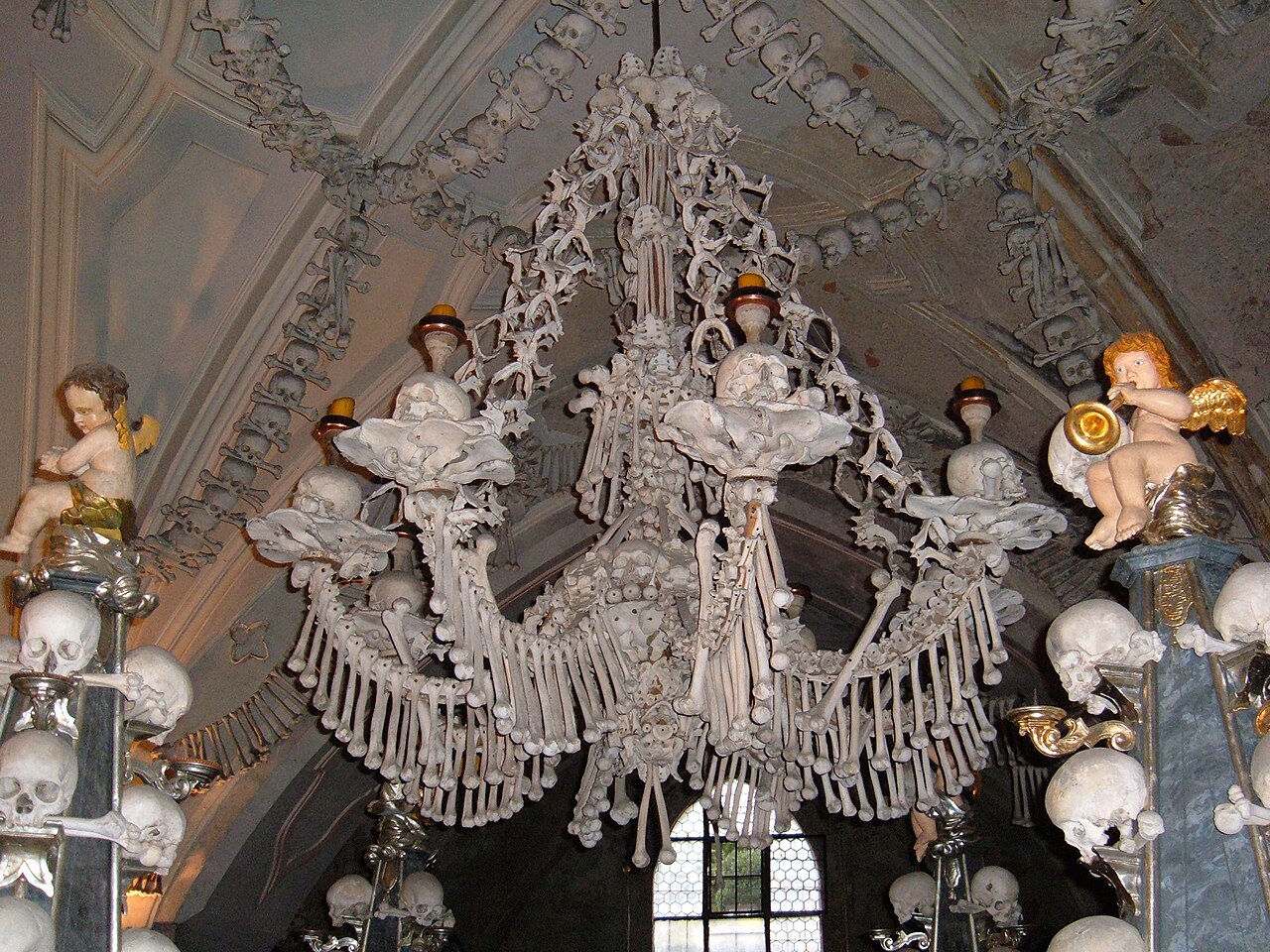
Under the small Cemetery Church of All Saints in Sedlec lies one of the most extraordinary chapels in the world. The cemetery became famous in the 13th century, when an abbot sprinkled it with soil brought from Golgotha, and thousands of people wanted to be buried here, especially during the Black Death and the Hussite wars. When space ran out, the bones were moved into the chapel.
In 1870, the woodcarver František Rint arranged the remains of tens of thousands of people into the decoration you see today: garlands of skulls, pyramids of bones in the corners, the coat of arms of the Schwarzenberg family and a huge chandelier that contains every bone of the human body. Rint even signed his work in bones.
Why we recommend it: nothing else looks like it, and it makes you think about death in a way that is more reflective than macabre.
Area: Sedlec · Price: CZK 180 adults (about $8) · Tickets: timed entry, buy online at sedlec.info or at the Sedlec Information Centre · Hours: about 9 a.m.–4 p.m. in winter, longer from spring to autumn · Time needed: 30 minutes
Tip: Capacity is limited, so buy a time slot online before you go, and only from the official site: resellers charge far more. It is a consecrated chapel, so keep your voice down.
See Sedlec Ossuary tours with transport from Prague
2. Cathedral of the Assumption, Sedlec

A five-minute walk from the ossuary stands the Cathedral of the Assumption of Our Lady and St. John the Baptist, once the church of the first Cistercian monastery in Bohemia. Built around 1300, it was burned in the Hussite wars and rebuilt in the early 18th century by the architect Jan Blažej Santini-Aichel in his unique “Baroque Gothic” style, mixing Gothic forms with Baroque light and movement.
The bright white interior, with its swirling vaults and tall windows, is a striking contrast to the ossuary. It shares the UNESCO listing with St. Barbara’s.
Why we recommend it: most visitors only see the bones and miss one of the most original church interiors in Czechia, right next door.
Area: Sedlec · Price: CZK 180 adults · Time needed: 30–45 minutes
Tip: Ask at the Sedlec Information Centre about the combined ticket with St. Barbara’s Cathedral before you buy single tickets.
3. St. Barbara’s Cathedral

The Church of St. Barbara, patron saint of miners, was begun in 1388 by the miners of Kutná Hora, who wanted a church to rival St. Vitus in Prague. Work went on for centuries: master builders including Matěj Rejsek and Benedikt Ried shaped its soaring vaults, and it was only finished in 1905. Outside, its tent-like triple roof and flying buttresses make one of the most distinctive silhouettes in Central Europe.
Inside, look up at the net and star vaults decorated with the coats of arms of the mining guilds, and find the rare Gothic frescoes in the chapels showing miners and minters at work. The upper gallery offers views down into the nave.
Why we recommend it: it is one of the most beautiful Gothic churches in Europe, and few cathedrals tell the story of the people who paid for them so clearly.
Area: historic center · Price: CZK 180 adults · Hours: 10 a.m.–5 p.m. (November–December, March), 10 a.m.–4 p.m. (January–February), 9 a.m.–6 p.m. (April–October); closed December 24 · Time needed: 1 hour
Tip: Walk around the outside to the terrace behind the apse, where the view over the valley and the old town is free.
4. Barborská Street and the Jesuit College

The approach to St. Barbara’s leads along Barborská Street, lined on one side by the long Jesuit College, built in the 17th century, and on the other by a terrace with a row of Baroque saints’ statues, often compared to Charles Bridge in Prague. The college now houses GASK, the gallery of the Central Bohemian Region, with modern and contemporary art.
From the terrace you look across the valley of the Vrchlice stream to the rooftops of the old town.
Why we recommend it: it is the grand entrance to St. Barbara’s and one of the most photogenic streets in Czechia.
Area: historic center · Price: street free; gallery tickets separate · Time needed: 20 minutes, more with the gallery
Tip: Walk Barborská toward the cathedral in the late afternoon, when the sun lights up the statues and the church front.
5. Italian Court (Royal Mint)

The Italian Court (Vlašský dvůr) was the economic heart of the medieval kingdom. In 1300, King Wenceslas II centralized all minting here and brought experts from Florence, which gave the building its name. For centuries it struck the Prague groschen, one of the most important coins of medieval Europe, and King Wenceslas IV added a royal palace with an audience hall and a chapel.
Guided tours visit the old minting workshops, the audience hall, the royal chapel and the cellars. You can even stamp your own groschen on a replica press.
Why we recommend it: it explains why Kutná Hora was so rich, and minting a coin yourself is fun for all ages.
Area: historic center · Price: Royal Mint CZK 120, Royal Palace CZK 190, all three tours CZK 260 (adults); coin minting CZK 50 · Time needed: 1–1.5 hours
Tip: The combined tour (CZK 260) is the best value if you want both the mint and the royal rooms. The Royal Palace sometimes opens late on days with weddings, so check before you go.
6. Hrádek and the Medieval Silver Mine

Hrádek, a Gothic residence of the 15th century, is home to the Czech Museum of Silver. Tour I covers the history of Kutná Hora and its “silver nobility”. Tour II, “The Way of Silver”, is the highlight: you put on a white miner’s coat and a helmet and walk through a narrow medieval mine gallery under the town, then see a reconstructed horse-powered winch and the processing of ore into coins.
The mine passage is low, narrow and wet in places, which is exactly how it felt to the miners of the Middle Ages.
Why we recommend it: it is the only way to experience what made Kutná Hora rich, from the inside.
Area: Barborská Street · Price: Tour I CZK 100, Tour II (mine) CZK 200, both CZK 270 (adults) · Season: tours April–November, Tuesday–Sunday; exhibitions only in December–January; closed in February · Time needed: 1.5–2.5 hours
Tip: Reserve the mine tour online, wear sturdy shoes and skip it if you are claustrophobic. Children are admitted to the mine from age 7.
7. Church of St. James

Next to the Italian Court, the Church of St. James (sv. Jakub) is the oldest church in the historic center, built in the 14th century, when the town was at the height of its silver boom. Its tall, slightly leaning tower is the landmark of the old town and appears in almost every view of Kutná Hora.
The interior is mostly Baroque, with paintings by notable Czech Baroque artists, though it is not always open outside services.
Why we recommend it: together with the Italian Court, it forms the oldest and most picturesque corner of Kutná Hora.
Area: historic center · Price: free to view from outside · Time needed: 15 minutes
Tip: For the classic photo of St. James and the Italian Court together, walk down to the park below the Italian Court terrace.
8. Stone Fountain and the Old Town Squares

On Rejskovo Square stands the Stone Fountain (Kamenná kašna), a twelve-sided late-Gothic water reservoir from the 1490s, attributed to Matěj Rejsek, the builder who also worked on St. Barbara’s. Water was precious in a mining town, and this fountain held the supply brought in by wooden pipes.
Nearby, the Stone House (Kamenný dům) has one of the most richly carved Gothic facades in the country and houses part of the Czech Museum of Silver.
Why we recommend it: these small squares show how prosperous the town was beyond its famous churches.
Area: historic center · Price: free · Time needed: 30 minutes
Tip: Combine the fountain, the Stone House and Palackého náměstí in a short loop between the Italian Court and St. Barbara’s.
9. Palackého náměstí and the Kuttenberg Tour

Palackého náměstí is the main square of Kutná Hora, lined with colorful burghers’ houses and cafés, and the meeting point for walks around the old town. Since 2025, Kutná Hora has a new kind of visitor: fans of the video game Kingdom Come: Deliverance II, set in 1403, which recreates the medieval town as “Kuttenberg”.
The local guide service offers a “Silver Kuttenberg” walk that compares scenes from the game with the real streets and buildings, includes entry to one historic site and lets you mint a coin. You do not need to have played the game to enjoy it.
Why we recommend it: it is a fresh way to see the town through medieval eyes, and something no other guide to Kutná Hora will offer you.
Area: historic center · Price: Silver Kuttenberg tour CZK 650 per person · Duration: about 2 hours, in English or German on request · Booking: recommended in advance
Tip: If you prefer to explore alone, the classic “Storytour” guided walk through the historic center costs CZK 300.
See Kingdom Come: Deliverance tours
10. St. Barbara Viewpoint below the Jesuit College

For the most famous view of Kutná Hora, walk down from the Jesuit College terrace toward the valley. From the slopes and the vineyard below, St. Barbara’s rises above the trees with its triple tent roofs and buttresses, with the long front of the Jesuit College beside it.
Vines have been grown on these slopes for centuries, and the view at sunset, when the stone turns golden, is the one on every postcard of the town.
Why we recommend it: it is free, quiet and the best way to understand the scale of the cathedral.
Area: below Barborská Street · Price: free · Best time: late afternoon and sunset
Tip: Bring a long lens or zoom: from the valley you can frame St. Barbara’s and the Jesuit College together.
Must-Do Experiences in Kutná Hora
Some of the best moments in Kutná Hora are not attractions with a ticket. These are the experiences we would not skip:
- Walk into a medieval mine. Put on the miner’s coat and helmet at Hrádek and squeeze through the old gallery.
- Mint your own groschen. Strike a replica Prague groschen at the Italian Court for CZK 50.
- Stay for the evening. After the day-trippers leave, the old town and the lit-up cathedral are almost empty.
- Taste local wine. Kutná Hora has its own small wine tradition on the slopes below St. Barbara’s.
- See both cathedrals. Compare Santini’s Baroque Gothic at Sedlec with the pure late Gothic of St. Barbara’s on the same day.
See guided tours of Kutná Hora
Where to Eat in Kutná Hora
| Place | Area | What to order | Good to know |
|---|---|---|---|
| Restaurants on Palackého náměstí | Historic center | Czech classics, local beer | Convenient between the Italian Court and St. Barbara’s |
| Cafés on Barborská Street | Near St. Barbara’s | Coffee, cakes | Good rest stop with views of the valley |
| Pubs around Sedlec | Near the ossuary | Quick lunch before the train | Handy if you only visit Sedlec |
| Any weekday lunch menu | Everywhere | Soup and main course | Usually cheaper than in Prague |
Tip: many day-trippers eat near the ossuary and rush back to Prague. Eat in the historic center instead, and use lunch as the break between Sedlec and St. Barbara’s.
What Do Kutná Hora’s Top Sights Cost in 2026?
There is no city pass for Kutná Hora, but entry fees are low. These are the 2026 adult prices for the sights in this guide:
| Sight | Adult price | Good to know |
|---|---|---|
| Sedlec Ossuary | CZK 180 | Timed entry; buy online |
| Cathedral of the Assumption, Sedlec | CZK 180 | Ask about combined tickets |
| St. Barbara’s Cathedral | CZK 180 | Open daily (closed December 24) |
| Italian Court, all three tours | CZK 260 | Or CZK 120 for the mint only |
| Hrádek mine tour (Tour II) | CZK 200 | April–November; closed Mondays |
| Total for the five | CZK 1,000 (about $45) |
Our verdict: a full day in Kutná Hora costs around CZK 1,000 per adult in entry fees, plus a return train ticket. Doing it on your own is much cheaper than an organized day trip from Prague, but a tour makes sense if you want transport, timed tickets and a guide handled for you.
Compare Kutná Hora day trips from Prague
Where to Stay in Kutná Hora
| Area | Best for | Pros | Cons |
|---|---|---|---|
| Historic center | Couples and first-time visitors | Walk to St. Barbara’s and the Italian Court, quiet evenings | Hilly streets with luggage |
| Sedlec | Early trains and the ossuary | Close to the main station | 3 km from the old town |
| Near Kutná Hora město station | Short stays | Easy rail connection, a few minutes to the center | Fewer restaurants nearby |
Use the map below to compare hotels and apartments across these areas. Prices update live for your dates, so set your check-in and check-out first.
Kutná Hora Itinerary: 1, 2 or 3 Days
- Day 1 – The essentials: morning train from Prague, Sedlec Ossuary (1) at your booked time and the Sedlec cathedral (2), local train to Kutná Hora město, lunch on Palackého náměstí (9), the Italian Court (5), the Stone Fountain (8), Barborská Street (4) and St. Barbara’s (3), sunset at the viewpoint (10).
- Day 2 – Silver and stories: Hrádek and the medieval mine (6), the Church of St. James (7) and the Silver Kuttenberg tour (9) in the afternoon.
- Day 3 – Onward: continue east to Brno, or back to Prague with a stop at the Gothic town of Kolín.
Day Trips from Kutná Hora
- Kolín: a historic town with a Gothic church and a large Jewish heritage, 15 minutes by train.
- Žleby Castle: a romantic chateau with a white deer park, about 20 minutes by car.
- Brno: about 2.5–3 hours by train, a natural next stop on the way to Moravia.
Getting There and Around
| Option | Price | Notes |
|---|---|---|
| Direct train from Prague (ČD) | Varies by ticket type | About 50–55 minutes to Kutná Hora hlavní nádraží (Sedlec). |
| Train via Kolín | Varies | Fast trains to Kolín, then a short regional train; useful if the direct train does not suit your time. |
| Local train hl. n. – město | Low regional fare | Shuttle between Sedlec and the historic center. |
| Day tour from Prague | See tour prices | Transport, guide and timed ossuary entry included. |
Money-Saving Tips
- Buy ossuary tickets only on the official site, sedlec.info: resellers charge inflated prices.
- Ask about combined tickets for the Sedlec monuments and St. Barbara’s.
- Choose the Italian Court combined tour (CZK 260) rather than paying for tours separately.
- Go independently by train: it costs far less than an organized tour.
- The views from Barborská Street, the cathedral terrace and the valley are free.
Best Time to Visit Kutná Hora
| Season | Weather | Crowds | Good to know |
|---|---|---|---|
| Spring (Mar–May) | Cool to mild | Low to medium | The silver mine reopens in April |
| Summer (Jun–Aug) | Warm | High at the ossuary | Royal Silver Festival in June; book ossuary slots |
| Autumn (Sep–Nov) | Mild, then cool | Medium | Grape harvest on the slopes; mine tours until November |
| Winter (Dec–Feb) | Cold | Low | Shorter hours; the mine is closed and Hrádek shuts in February |
Kutná Hora FAQ
Is Kutná Hora worth a day trip from Prague?
Yes. It is under an hour by train, and in one day you can see the Sedlec Ossuary, two UNESCO-listed cathedrals, the royal mint and a medieval mine.
Do you need to book the Sedlec Ossuary in advance?
It is strongly recommended. Tickets are for a specific date and time slot and capacity is limited. Buy them on the official site, sedlec.info.
How far is the Sedlec Ossuary from St. Barbara’s Cathedral?
About 3 km. Take the local train from Kutná Hora hlavní nádraží to Kutná Hora město, a city bus, or walk for about 40 minutes.
Is Kutná Hora the Kuttenberg from Kingdom Come: Deliverance II?
Yes. The game recreates medieval Kutná Hora as Kuttenberg, and the local guide service runs a “Silver Kuttenberg” tour (CZK 650) that compares the game with the real town.
Can children visit the Sedlec Ossuary and the silver mine?
Yes, but use your judgment: some children find the ossuary upsetting. The medieval mine at Hrádek admits children from age 7.
Extending Your Trip?
Kutná Hora is an easy add-on to Prague, under an hour away by train: our Prague guide covers the castle, Charles Bridge and the Visitor Pass math. Heading east, Brno has another remarkable ossuary, Villa Tugendhat and the Moravian wine country; read our Brno guide. For more UNESCO towns in Bohemia, see our guides to Český Krumlov and the spa town of Karlovy Vary. For an overview of the whole country, start with the best cities to visit in Czechia.
Sources (prices and opening hours checked in November 2026)
- Parish of Sedlec – ossuary and cathedral tickets
- Prague City Tourism – Sedlec cathedral hours
- St. Barbara’s Cathedral – tickets
- St. Barbara’s Cathedral – opening hours
- Průvodcovská služba Kutná Hora – Italian Court and Silver Kuttenberg tour
- Czech Museum of Silver – Hrádek tour prices
- Czech Museum of Silver – Hrádek opening hours
- Institute for Economics and Peace – Global Peace Index 2026