




Santo Domingo is the oldest European-founded city in the Americas, and most first-time visitors need 2 days: one for the Colonial Zone and one for the caves of Los Tres Ojos, the Columbus Lighthouse and the waterfront. This guide covers the 10 places worth your time, what each one costs in 2026 (including the newly reopened Alcázar de Colón), where to stay and how to get around.
This guide contains affiliate links. If you book through them, we may earn a small commission at no extra cost to you.
Why Visit Santo Domingo?
Founded by Bartholomew Columbus at the end of the 15th century, Santo Domingo was the first seat of Spanish rule in the New World. The first cathedral, the first university, the first hospital and the first paved street in the Americas were all built here, and its Ciudad Colonial is a UNESCO World Heritage Site. Today it is also a busy Caribbean capital of more than three million people. The city is known for:
- The Colonial Zone: 16th-century churches, palaces and fortresses in a compact, walkable grid.
- Firsts of the New World: the oldest cathedral and the oldest European fortress still standing in the Americas.
- Music: merengue and bachata were born in the Dominican Republic, and you hear them everywhere.
- Dominican food: la bandera (rice, beans and meat), mangú, sancocho and fresh tropical fruit.
- Value: museums cost a few dollars, and it is a cheaper base than the beach resorts.
Is Santo Domingo Right for You?
| Type of trip | How Santo Domingo fits |
|---|---|
| History and culture | Excellent: the richest colonial heritage in the Caribbean, in a small, walkable area. |
| Couples and romantic trips | Good: candlelit courtyards, rooftop bars and live music in the Colonial Zone. |
| Families with kids | Good: fortresses, the caves of Los Tres Ojos and short distances. The heat and traffic need planning. |
| Budget travelers | Very good: cheap museums, street food and guesthouses, and buses to the rest of the country. |
| Beach holidays | Fair: the city has no swimming beach; Boca Chica is about 30 minutes away. |
| Travelers with limited mobility | Challenging: uneven cobbles, narrow sidewalks and few ramps in the Colonial Zone. |
Santo Domingo Quick Facts
| Best time to visit | December–April: drier and a little cooler. The Atlantic hurricane season runs from June 1 to November 30. |
|---|---|
| How many days | 2 days, or 3 with a beach day trip. |
| Airport | Las Américas International Airport (SDQ), about 30 km east of the center. Use the official airport taxis or Uber. |
| Getting around | Walk the Colonial Zone; use Uber or taxis for longer trips. The metro costs RD$20 per ride. |
| Entry | Fill in the free e-Ticket (eticket.migracion.gob.do) before your flight. The tourist card is included in your airfare. |
| Currency | Dominican peso (RD$). In November 2026, US$1 was worth about RD$60. Cards are widely accepted; carry pesos for small shops. |
Know Before You Go
Is Santo Domingo a walkable city?
The Colonial Zone is very walkable: from Parque Colón to the Alcázar de Colón takes about 5 minutes, and the whole area can be crossed in 15–20 minutes. Outside it, Santo Domingo is a large, car-oriented city with heavy traffic and few pedestrian crossings, so use Uber or a taxi to reach the Malecón hotels, Los Tres Ojos or the Columbus Lighthouse. Walk early or late in the day: the midday heat is intense for much of the year.
Is Santo Domingo safe?
The US State Department rates the Dominican Republic at Level 2, “exercise increased caution”, because of crime. The Colonial Zone has a visible tourist police presence and is generally safe during the day and in the busy evening areas. The main risks are bag and phone snatching, sometimes from motorbikes, and pickpockets in crowds. Keep your phone away from the curb, avoid showing jewelry or cash, use ride-hailing apps at night rather than street taxis, and avoid quiet streets after dark. The emergency number is 911.
Does Santo Domingo have Uber?
Yes. Uber and other ride-hailing apps work well in Santo Domingo, and they are usually cheaper than taxis and avoid fare negotiations. Official airport taxis wait outside arrivals at Las Américas; confirm the fare before you get in. Inside the Colonial Zone you will hardly need a car.
How do you get around Santo Domingo?
Most visitors combine walking with Uber. The metro has two lines and costs RD$20 per ride; an integrated fare of RD$35 lets you combine the metro, the urban cable car and the main bus corridors within 90 minutes. The metro is useful to cross the city, but it does not serve the Colonial Zone directly. For trips to Punta Cana, Samaná or Puerto Plata, long-distance coaches (Expreso Bávaro, Caribe Tours) are cheap and comfortable.
Map of the Best Places to Visit in Santo Domingo
The numbers on the map match the list below. Los Tres Ojos (9) and the Columbus Lighthouse (10) are across the Ozama River, about 15–20 minutes by car from the Colonial Zone.
10 Best Places to Visit in Santo Domingo
1. Calle Las Damas

Calle Las Damas is considered the first paved street in the Americas, laid out in the early 1500s. Its name, the “Street of the Ladies”, is said to come from the wife of Diego Colón, María de Toledo, and the women of her court, who walked along it to the cathedral.
The short street lines up some of the Colonial Zone’s most important buildings: the Fortaleza Ozama at its southern end, the Casa de Ovando (once the governor’s house, now a hotel), and the National Pantheon, a former Jesuit church where Dominican national heroes are buried. A soldier guards the entrance of the Pantheon, and the changing of the guard is a small ceremony worth watching.
Why we recommend it: in 300 meters it tells the story of the first decades of Spanish America, and it is free.
Area: Ciudad Colonial · Price: free · Time needed: 30 minutes · Best time: early morning or late afternoon
Tip: Visitors to the National Pantheon must wear long trousers or skirts and covered shoulders. Combine the street with the Fortaleza Ozama, which opens onto it.
See Colonial Zone walking tours
2. Catedral Primada de América

The Cathedral of Santa María la Menor, better known as the Catedral Primada de América, is the oldest cathedral in the Americas. Construction began in the 1510s, and the church was consecrated in 1541. Its coral-limestone facade, in Plateresque style, faces Parque Colón, while the interior mixes Gothic vaults with chapels added over the centuries.
For a long time the cathedral held what were believed to be the remains of Christopher Columbus, until they were moved to the Columbus Lighthouse in 1992. Inside, look for the side chapels with tombs of colonial officials and bishops, and the coral stone that gives the walls their warm color.
Why we recommend it: standing in the first cathedral of the New World is one of the essential experiences of the city.
Area: Parque Colón · Price: free during mass; a ticket may be charged for tourist visits at other times · Time needed: 30–45 minutes · Dress code: covered shoulders and knees
Tip: Daily masses take place early in the morning and in the early evening; avoid them if you want to walk around freely. Look up at the bell tower base from the Plaza de los Curas, the small square beside the cathedral.
3. Alcázar de Colón

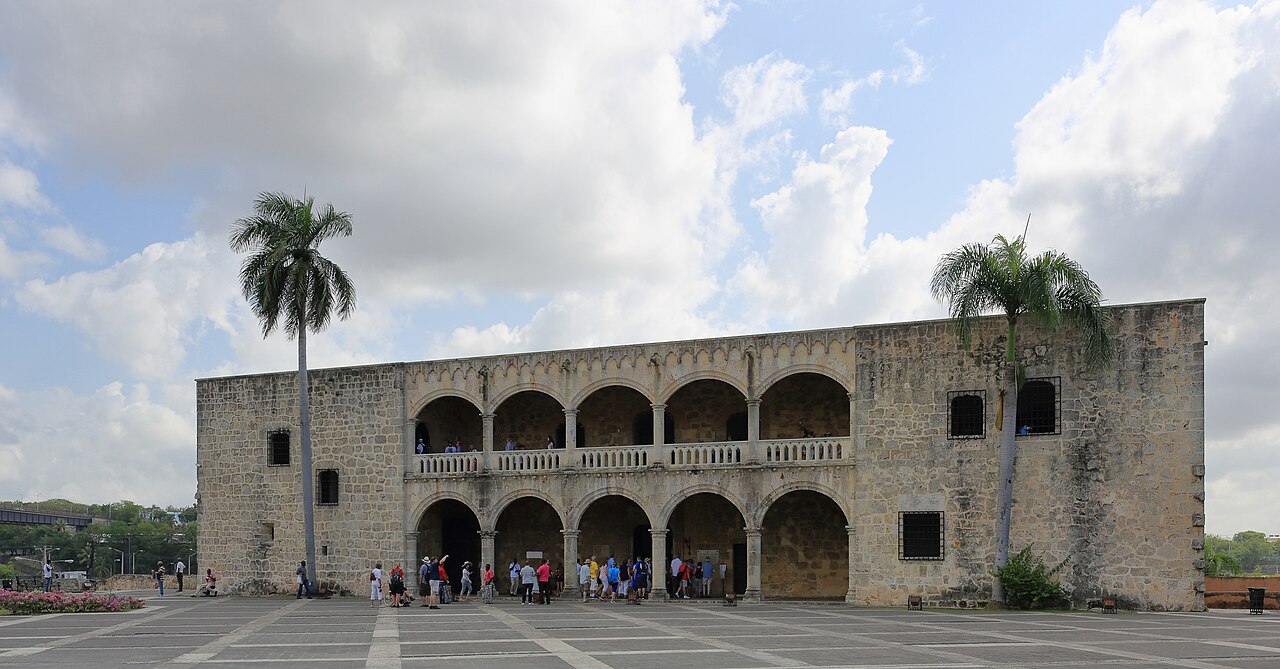
Christopher Columbus’s son Diego, governor of the Indies, built this palace between about 1510 and 1514 as the seat of the first viceroyal court in the Americas. It overlooks the Ozama River from the Plaza de España, with two levels of open arcades and walls of coral limestone.
After a long renovation, the museum reopened on September 29, 2026 as the Museo Diego Colón Palacio Virreinal. The new display covers 17 rooms and four galleries, with audiovisual and interactive features, period furniture and a courtyard with views over the river. It tells the story of the Columbus family and of colonial life in the 16th century.
Why we recommend it: it is the most visited museum in the country, and the renovation makes it much more engaging than before.
Area: Plaza de España · Price: RD$200 (about US$3.30) after the first month of reopening · Hours: Tuesday–Sunday (sources differ on exact times; call +1 809-960-9371 to confirm) · Time needed: 1–1.5 hours
Tip: Come back to the Plaza de España in the evening, when the palace is lit up and the terraces of the restaurants opposite fill up.
Good to know – the Monday closure: most state museums in the Colonial Zone, including the Alcázar de Colón, close on Mondays. Use Monday for walking the streets, the cathedral, the Malecón or a beach day, and keep the museums for Tuesday to Sunday.
4. Fortaleza Ozama

The Fortaleza Ozama, built from 1502, is the oldest European military fortification still standing in the Americas. It guarded the mouth of the Ozama River, where ships arrived, and remained in military use for centuries, including as a prison.
Its centerpiece is the Torre del Homenaje, a square stone keep about 18 meters high. You can climb to the top for views over the river, the port and the rooftops of the Colonial Zone. In the large courtyard, a statue of the chronicler Gonzalo Fernández de Oviedo, once commander of the fort, stands among old cannons. Interpretive rooms explain the history of the city’s defenses.
Why we recommend it: the view from the tower and the sense of age make it one of the best-value visits in the city.
Area: Calle Las Damas · Price: about RD$100 (around US$2) · Closed: Mondays · Time needed: 45 minutes
Tip: The courtyard has almost no shade. Visit first thing in the morning or in the late afternoon, and bring water.
5. Museo de las Casas Reales

Built in 1511 on the orders of King Ferdinand of Aragon, the Casas Reales housed the Real Audiencia, the first royal court of appeal in the Americas, and the offices of the colonial government. The building sits on the south side of the Plaza de España, facing the Alcázar.
Today it is the museum that best explains everyday colonial life: maps and navigation instruments, weapons and armor, furniture, a sugar mill model and displays about the Taíno people, the island’s original inhabitants. The courtyard and its galleries are a cool, quiet break from the street.
Why we recommend it: it gives you the context to understand everything else you see in the Colonial Zone.
Area: Plaza de España · Price: a small fee, about RD$100–150 · Closed: Mondays · Time needed: 1 hour
Tip: Visit the Casas Reales and the Alcázar de Colón on the same morning: they face each other across the Plaza de España.
6. Calle El Conde and Parque Colón

Calle El Conde is the pedestrian main street of the Colonial Zone, running about a kilometer from Parque Colón to the Puerta del Conde. It is lined with shops, cafés, money changers, street vendors and musicians, and it is busy from morning to night.
At its eastern end, Parque Colón is the heart of the old city, with a statue of Christopher Columbus facing the cathedral. At its western end stands the Puerta del Conde, an old city gate where Dominican independence was proclaimed on February 27, 1844. Just behind it, Parque Independencia holds the Altar de la Patria, the mausoleum of the country’s founding fathers.
Why we recommend it: it is the best place to feel the everyday life of the city, and it links the main sights.
Area: Ciudad Colonial · Price: free · Time needed: 1 hour · Best time: late afternoon and evening
Tip: Exchange money at a bank or official exchange house, not with people offering rates in the street.
7. Ruins of the Monastery of San Francisco

The Franciscan monastery, begun in the early 16th century, was the first monastery in the Americas. Earthquakes, pirate attacks (including Francis Drake’s raid in 1586) and centuries of neglect left it in ruins, and later it was used as a hospital and asylum.
Today the roofless walls and arches on a small hill at the northern edge of the Colonial Zone are one of the most atmospheric spots in the city. The site is often used for concerts, and on Sunday evenings live son and merengue music frequently draws locals and visitors to dance among the ruins.
Why we recommend it: the ruins are free to see from outside, beautiful at sunset and, on music nights, the liveliest place in the old town.
Area: northern Ciudad Colonial · Price: free to see; events may charge entry · Time needed: 30 minutes, or an evening for a concert
Tip: Ask at your hotel or check local listings for the Sunday concert, as schedules can change.
8. Malecón

The Malecón, officially Avenida George Washington, runs for several kilometers along the Caribbean Sea west of the Colonial Zone. It is lined with palm trees, monuments, large hotels and casinos, and the sea breeze makes it cooler than the streets inland.
The waterfront is rocky rather than sandy, so it is a place to walk, jog and watch the sunset, not to swim. At its eastern end, near the Colonial Zone, the Obelisco is a landmark often painted with murals. On weekends and holidays, Dominican families come here for street food, music and the sea views.
Why we recommend it: it is the best place in the city for a sunset walk and a cold drink by the sea.
Area: Malecón / Gazcue · Price: free · Time needed: 1 hour · Best time: sunset
Tip: The sea here is rough and there are no lifeguards; do not swim. Stick to the busy stretches near the hotels at night.
9. Los Tres Ojos

Los Tres Ojos (“The Three Eyes”) is a series of open-air limestone caves with underground lakes in Mirador del Este park, on the eastern side of the Ozama River. Steps lead down into the caves, past stalactites, ferns and hanging roots, to pools of clear water in shades of green and blue.
There are in fact four lakes. Three are reached on foot; the fourth, open to the sky and surrounded by jungle, is reached by crossing one lake on a small raft pulled by a rope. The site was used by the Taíno people and has been a national park since the 1970s.
Why we recommend it: it is a cool, green escape from the city, only 20 minutes from the Colonial Zone.
Area: Santo Domingo Este · Price: a small entrance fee (a few US dollars), plus a small charge for the raft · Hours: daily, about 8:30 a.m.–5:30 p.m. · Time needed: 1 hour
Tip: The steps are steep and can be slippery; wear shoes with grip. Combine the visit with the Columbus Lighthouse, a few minutes away.
Compare Los Tres Ojos and Columbus Lighthouse tours
10. Columbus Lighthouse (Faro a Colón)

The Faro a Colón is a huge concrete monument in the shape of a cross, completed in 1992 for the 500th anniversary of Columbus’s arrival in the Americas. It is about 240 meters long, and at night powerful lights project a cross onto the sky above the city.
The monument is also a mausoleum: it holds what the Dominican Republic says are the remains of Christopher Columbus, moved here from the cathedral (Seville Cathedral, in Spain, also claims to hold them). Inside, rooms display exhibits donated by countries across the Americas and Europe.
Why we recommend it: it is a strange, monumental building, and the Columbus debate makes for a fascinating visit.
Area: Santo Domingo Este · Price: a small entrance fee · Hours: Tuesday–Sunday, about 9 a.m.–5 p.m. · Time needed: 45 minutes
Tip: The light projection is only switched on occasionally because of its electricity use, so do not plan an evening around it.
Must-Do Experiences in Santo Domingo
Some of the best moments in Santo Domingo do not need a ticket. These are the experiences we would not skip:
- Eat la bandera. Rice, red beans, stewed meat and salad, the Dominican “flag”, is the classic lunch at any local comedor.
- Try mangú for breakfast. Mashed green plantains with pickled red onions, fried cheese, salami and eggs, known as “los tres golpes”.
- Dance or listen to merengue and bachata. Bars in the Colonial Zone have live music most nights.
- Have a cold Presidente. The local beer is served ice-cold, often in bottles wrapped in a paper sleeve.
- Watch a baseball game. From about October to January, the winter league plays at Estadio Quisqueya, and the atmosphere is unforgettable.
See Santo Domingo food and cultural tours
Where to Eat in Santo Domingo
| Place | Area | What to order | Good to know |
|---|---|---|---|
| Local comedores | Everywhere | La bandera, sancocho | The cheapest lunch in the city; look for places full of office workers |
| Pat’e Palo | Plaza de España | European-Caribbean dishes | A terrace facing the Alcázar; best in the evening |
| Mesón de la Cava | Mirador Sur | Steak and seafood | A restaurant inside a natural cave; book ahead |
| Adrian Tropical | Malecón | Mofongo, tostones, fresh juice | Open late, with sea views |
| Street stalls | Malecón, Calle El Conde | Chicharrón, empanadas, fresh coconut | Choose busy stalls with a quick turnover |
Tip: at lunchtime, many comedores offer a plato del día (dish of the day) for a fraction of what you pay in tourist restaurants. Restaurant bills usually include an 18% tax and a 10% service charge, so check before adding a tip.
What Do Santo Domingo’s Colonial Sights Cost in 2026?
Santo Domingo has no tourist city card, but you do not need one: the main museums are cheap and pay-as-you-go. We added up the Colonial Zone essentials with November 2026 prices (US$1 ≈ RD$60).
| Sight | Price | About in US$ | Notes |
|---|---|---|---|
| Alcázar de Colón (Museo Diego Colón) | RD$200 | US$3.30 | Reopened September 29, 2026 |
| Fortaleza Ozama | about RD$100 | US$1.70 | Includes the tower |
| Museo de las Casas Reales | about RD$100–150 | US$1.70–2.50 | Closed Mondays |
| Calle Las Damas, Calle El Conde, San Francisco ruins, Malecón | Free | – | Walk them at your own pace |
| Total for the Colonial Zone | about RD$400–450 | about US$7–8 | Less than a single guided tour |
Our verdict: you can see every major sight of the Colonial Zone for less than US$10 in entrance fees. A guided walking tour is worth it for the stories behind the buildings, but book one that does not include the museum entries at inflated prices, and pay the small fees yourself at the door.
Where to Stay in Santo Domingo
| Area | Best for | Pros | Cons |
|---|---|---|---|
| Ciudad Colonial | First-time visitors and couples | Walk to every sight, boutique hotels in colonial houses | Bars can be noisy at night |
| Gazcue | Budget travelers | Quiet, leafy, close to the Malecón and the Colonial Zone | Fewer restaurants |
| Malecón | Sea views and big hotels | Large hotels with pools, sunsets over the sea | You need a car or Uber for most sights |
| Piantini / Naco | Business and shopping | Modern area, malls and restaurants | Far from the historic center |
Use the map below to compare hotels and apartments across these areas. Prices update live for your dates, so set your check-in and check-out first.
Santo Domingo Itinerary: 1, 2 or 3 Days
- Day 1 – The Colonial Zone: Calle Las Damas (1) and the Fortaleza Ozama (4) in the morning, the Alcázar de Colón (3) and the Casas Reales (5), lunch at a comedor, the cathedral (2) and Calle El Conde (6) in the afternoon, sunset at the San Francisco ruins (7).
- Day 2 – East bank and waterfront: Los Tres Ojos (9) and the Columbus Lighthouse (10) in the morning, a rest in the afternoon, a sunset walk on the Malecón (8) and dinner in the Colonial Zone.
- Day 3 – Beach or day trip: Boca Chica beach, or a full-day trip to Saona Island or Altos de Chavón.
With only one day, focus on the Colonial Zone: Calle Las Damas, the Fortaleza Ozama, the Alcázar, the cathedral and Calle El Conde.
Day Trips from Santo Domingo
- Boca Chica: a shallow, calm beach protected by a reef, about 30 minutes east; busy with Dominican families on weekends.
- La Romana and Altos de Chavón: a replica Mediterranean village above the Chavón River, about 1.5–2 hours east. See our La Romana guide.
- Saona Island: boat trips leave from Bayahibe, about 2 hours away; many tours include pickup from Santo Domingo.
- Samaná: about 2.5–3 hours by the Samaná highway, for whales (January–March), El Limón waterfall and Los Haitises.
Compare day trips from Santo Domingo
Getting There and Around
| Option | Price | Notes |
|---|---|---|
| Airport taxi or Uber from SDQ | Varies | About 30–45 minutes to the Colonial Zone, depending on traffic. Agree on the taxi fare before leaving. |
| Metro | RD$20 per ride | Two lines; RD$35 integrated fare to combine with the cable car and bus corridors within 90 minutes. |
| Uber | Varies | The easiest way to get around outside the Colonial Zone. |
| Expreso Bávaro coach to Punta Cana | About RD$500 | Several departures a day; about 3 hours. |
| Caribe Tours coaches | About RD$200–600 | To Samaná (about 2.5–3 hours), Puerto Plata (about 4 hours) and other cities. |
Money-Saving Tips
- Walk the Colonial Zone: its streets, squares and ruins are free, and the museums cost only a few dollars.
- Eat at comedores at lunchtime, where a full plato del día costs much less than a tourist menu.
- Use Uber instead of street taxis, and the metro for long trips across the city.
- Pay in pesos rather than dollars in shops and restaurants; dollar prices often use a poor exchange rate.
- Travel by coach to Punta Cana, Samaná or Puerto Plata instead of booking private transfers.
Best Time to Visit Santo Domingo
| Season | Weather | Crowds | Good to know |
|---|---|---|---|
| Winter (Dec–Feb) | Warm and drier | High | Carnival parades on Sundays in February, around Independence Day (February 27) |
| Spring (Mar–May) | Hot, rains increase in May | Medium; high at Easter | Easter week is a major holiday; beaches fill up |
| Summer (Jun–Aug) | Very hot and humid | Medium | Hurricane season starts June 1 |
| Autumn (Sep–Nov) | Hot, rainy | Low | Peak of the hurricane season; lowest hotel prices |
Santo Domingo FAQ
How many days do you need in Santo Domingo?
Two days is ideal: one for the Colonial Zone and one for Los Tres Ojos, the Columbus Lighthouse and the Malecón. Add a third day for a beach or Saona Island.
Is Santo Domingo worth visiting?
Yes, especially if you are interested in history. It has the oldest cathedral and fortress in the Americas, and it is a great contrast to the all-inclusive resorts of Punta Cana.
Is Santo Domingo safe for tourists?
The Colonial Zone is generally safe with normal precautions. The US State Department advises increased caution in the Dominican Republic because of crime; watch out for phone and bag snatching and use ride-hailing apps at night.
How much does the Alcázar de Colón cost?
The Alcázar de Colón reopened on September 29, 2026 as the Museo Diego Colón, and entry costs RD$200 (about US$3.30) after its first month. It is closed on Mondays.
Where should I stay in Santo Domingo for the first time?
In the Colonial Zone, to walk to every sight, or in Gazcue for a quieter and cheaper base close to both the Colonial Zone and the Malecón.
Extending Your Trip?
Planning a longer trip around the Dominican Republic? Punta Cana is about 3 hours east by coach: read our guide to the best places to visit in Punta Cana. On the way, stop in La Romana for Altos de Chavón and Saona Island, or head north to Samaná and Puerto Plata. See our guides to Samaná and Puerto Plata.
Sources (prices and opening hours checked in November 2026)
- Turisdom – Alcázar de Colón reopening, hours and price
- Dirección General de Museos – museum visits
- Dominican Republic Ministry of Tourism – entry requirements
- Dirección General de Migración – official e-Ticket
- El Caribe – metro fare and integrated fare
- Revista Mercado – Banco Central exchange rate, November 2026
- Dominican Republic Ministry of Tourism – getting around
- US State Department – Dominican Republic travel advisory