



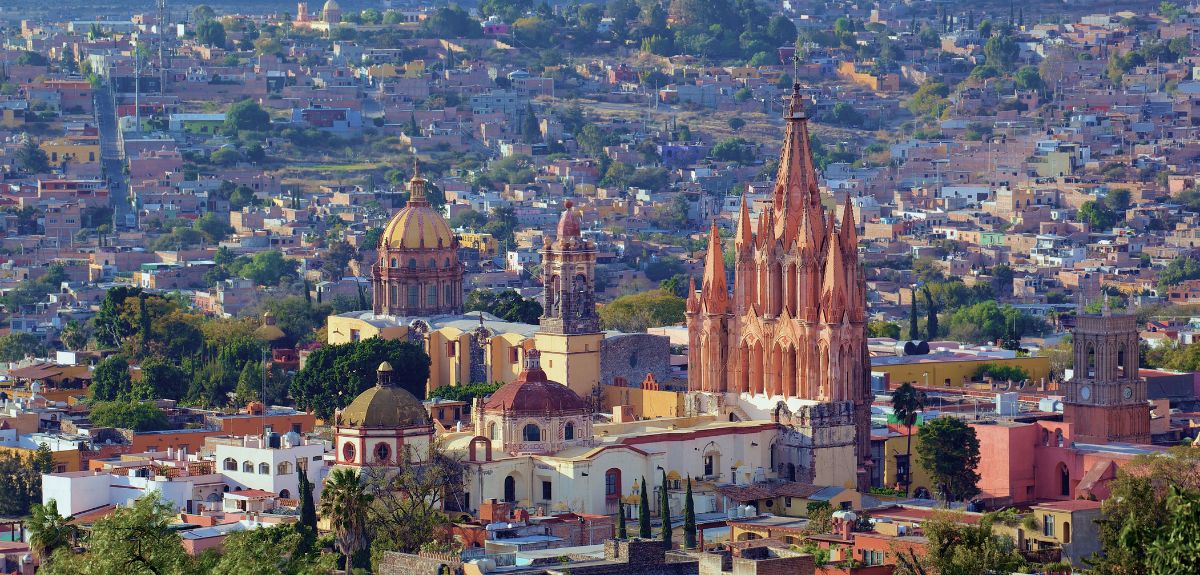
San Miguel de Allende looks the way a colonial Mexican town is supposed to look, which is exactly why it draws artists, retirees, and travelers in equal numbers. Pink stone church spires rise over cobblestone streets lined with centuries-old facades painted in ochre and terracotta, and the whole historic center has been protected as a UNESCO World Heritage Site since 2008. Unlike some picture-perfect towns, though, San Miguel has real depth: a serious art school tradition, working craft markets, and pilgrimage sites that predate the tourists by centuries.
Why Visit San Miguel de Allende?
Whether you’ve come for the architecture, the art scene, or the surrounding countryside, San Miguel offers one of Mexico’s most rewarding colonial-town experiences:
- Parroquia de San Miguel Arcángel: See the pink neo-Gothic church spires that anchor the entire town, a 19th-century reimagining of the original colonial parish.
- El Jardín: Sit in the shaded main plaza where the whole town gathers, with the Parroquia’s towers rising directly over the square.
- El Charco del Ingenio: Wander a 170-acre botanical reserve and canyon just outside town, filled with cacti, wetlands, and a spring-fed pool.
- Sanctuary of Atotonilco: Visit the “Sistine Chapel of Mexico,” an 18th-century pilgrimage church covered in vivid painted murals of Christ’s life.
- El Mirador: Take in the classic postcard view of the entire town and its pink church spires from a hillside overlook just above the historic center.
San Miguel rewards slow mornings and long dinners as much as sightseeing. Between the architecture, the surrounding countryside, and a food and art scene shaped by decades of international residents, it’s a town that consistently exceeds the expectations set by its own photographs.
SAN MIGUEL DE ALLENDE KEY INFO
Everything you need to hit the ground running.
WHEN TO VISIT
November to March for cool, dry weather; September for Mexican Independence Day celebrations, which San Miguel takes especially seriously
HOW TO GET THERE
Fly into Querétaro Intercontinental Airport (QRO) or León/Del Bajío International Airport (BJX). It’s roughly a 1-1.5 hour shuttle or private transfer from either airport to San Miguel.
HOW TO GET AROUND
Walk within the historic center, and use taxis for trips to El Charco del Ingenio, the Sanctuary of Atotonilco, or other outlying sites.
IDEAL TRIP LENGTH
4-5 days for the town itself, but 6-7 days if you want to add day trips to Atotonilco, nearby hot springs, or the wine region toward Dolores Hidalgo.
What is San Miguel de Allende Mainly Known For?
San Miguel de Allende is known for its exceptionally well-preserved colonial architecture, protected as a UNESCO World Heritage Site alongside the nearby Sanctuary of Atotonilco since 2008. It’s also known as a longstanding artist colony, home to the Instituto Allende and a large community of American and Canadian expatriates and retirees drawn by the climate, culture, and pace of life. Beyond the architecture and art scene, the town played a key role in Mexican history as the birthplace of independence hero Ignacio Allende, for whom it’s named.
Is San Miguel de Allende a Walkable City?
Yes, genuinely so. The historic center is compact, and most major sights, restaurants, and shops sit within a 15-20 minute walk of El Jardín. Cobblestone streets and uneven sidewalks mean sturdy, comfortable shoes matter more here than in a flatter city.
Is it safe to walk in San Miguel de Allende? Yes, generally, both day and night in the historic center and surrounding tourist areas. As anywhere, standard caution applies in less-trafficked areas after dark.
What Is the Best Neighborhood to Walk Around?
The historic center around El Jardín is the obvious choice, with the Parroquia, boutique shops, and restaurants all within easy reach. For a quieter, more residential feel, the streets around Parque Juárez a few blocks south of the center offer a slower pace with fewer tourists and a stronger sense of everyday local life.
What Are the Best Things to Do in San Miguel de Allende? (For Your First Visit)
I let mornings run slow with coffee in the Jardín and used afternoons for the sights further out, since the historic center itself doesn’t require much rushing. Here’s what stood out:
Parroquia de San Miguel Arcángel
This pink-stone parish church, rebuilt in a dramatic neo-Gothic style in the late 19th century, is San Miguel’s defining landmark and visible from nearly anywhere in town. Local legend holds that the self-taught mason who redesigned the facade worked largely from postcards of European Gothic cathedrals. Price: Free to enter. Pro tip: Step inside during a quieter midweek morning to appreciate the interior without the crowds gathered outside for photos. Check availability and explore popular experiences.
El Jardín
This shaded main plaza, officially called Jardín Allende, is the social heart of San Miguel, ringed by arcaded colonial buildings, restaurants, and the towering Parroquia on its south side. Locals and visitors alike gather here throughout the day, especially in the evening when mariachi bands and street vendors fill the square. Price: Free. Pro tip: Grab a bench seat in the late afternoon and just watch the plaza come alive as the day cools down. Check availability and explore popular experiences.
El Mirador
A short taxi ride or a steep uphill walk from the center leads to this hillside viewpoint, delivering the definitive panoramic shot of San Miguel’s rooftops and church spires against the surrounding hills. It’s especially popular at sunset, when the light turns the town’s stone facades gold. Price: Free. Pro tip: Take a taxi up if you’d rather skip the climb, and combine the visit with a coffee or drink at one of the small cafes near the viewpoint. Check availability and explore popular experiences.
El Charco del Ingenio
This 170-acre botanical garden and nature reserve sits in a canyon just outside town, built around a spring-fed pool and an old reservoir that now attracts a wide range of birdlife. Its extensive cactus and succulent collection includes many species found nowhere else. Price: ~MXN 100. Pro tip: Go in the early morning for the best light and the most active birdlife around the wetland areas. Check availability and explore popular experiences.
.jpg)
Sanctuary of Atotonilco
About 25 minutes outside town, this 18th-century pilgrimage church is often called the “Sistine Chapel of Mexico” for the vivid murals covering nearly every interior surface, depicting scenes from the life and suffering of Christ. It’s also historically significant as the place where independence leader Miguel Hidalgo took up the banner of the Virgin of Guadalupe in 1810. Price: Free; donations appreciated. Pro tip: Dress modestly and move quietly, since this remains an active pilgrimage and retreat site rather than just a tourist stop. Check availability and explore popular experiences.
Instituto Allende
Founded in 1950 in a sprawling colonial-era building, this arts school helped transform San Miguel into an international artist colony and remains a working institution offering visual arts degrees in partnership with the Universidad de Guanajuato. Its courtyards and galleries are worth a look even for visitors not enrolled in a class. Price: Free to walk the grounds; workshops and classes have separate fees. Pro tip: Check the schedule for short-term art or photography workshops if you’re staying more than a few days; many are open to visitors without a full enrollment. Check availability and explore popular experiences.
Templo de San Francisco
Built between 1779 and 1799 by Franciscan friars, this church combines an ornate Churrigueresque stone facade, one of the most elaborate in town, with a more restrained neoclassical bell tower added later. It sits a short walk from El Jardín along one of San Miguel’s most photographed streets. Price: Free to enter. Pro tip: Look closely at the facade’s carved detail before heading inside; the contrast between the Baroque front and neoclassical tower tells its own story about the church’s long construction. Check availability and explore popular experiences.
Casa del Mayorazgo de la Canal
This 18th-century neoclassical mansion, built in stages by the wealthy Canal family between the 1730s and 1790s, sits right on the Jardín and is famous for one of the most photographed carved wooden doors in town. Now operated as a cultural space, it hosts rotating art exhibitions free to the public. Price: Free. Pro tip: Step inside if an exhibition happens to be running; the interior courtyard is worth seeing even beyond the famous facade. Check availability and explore popular experiences.
%20II.jpg)
Mercado de Artesanías
This crafts market stretches through a covered area and out along a narrow street just a few minutes from El Jardín, packed with stalls selling textiles, Talavera ceramics, hand-painted alebrijes, and jewelry made from local stones. It’s a livelier, more affordable counterpart to the boutiques closer to the main square. Price: Free to browse. Pro tip: Bargaining is expected here more than in the boutique shops downtown; a polite counteroffer usually gets you a better price. Check availability and explore popular experiences.
Parque Juárez
This shaded colonial-era park a few blocks south of the center offers a quieter green space than the busier Jardín, with mature trees, walking paths, and a small pond. It’s a favorite spot for locals to relax away from the tourist crowds, especially on weekend afternoons. Price: Free. Pro tip: Combine a visit here with a walk through the surrounding residential streets, one of the more authentic, less commercial corners of the historic center. Check availability and explore popular experiences.

Must-Do Activities in San Miguel de Allende
To really get the most out of your trip, I recommend checking out these experiences:
No products were found!
What Part of San Miguel de Allende is Best for Tourists?
Stay in the Centro (historic center) within walking distance of El Jardín, the Parroquia, and the main restaurant and shopping streets. Travelers looking for a quieter, more residential base sometimes choose the streets near Parque Juárez instead, still an easy walk from the main plaza but with a calmer, more local feel.
What to Know Before Going to San Miguel de Allende
- Stick to Bottled Water: Tap water isn’t recommended for visitors; stick to bottled water throughout your stay.
- Wear Sturdy Shoes: Cobblestone streets and uneven sidewalks are the norm throughout the historic center; leave the sandals at home.
- Altitude is Noticeable: San Miguel sits at nearly 6,200 feet above sea level; take it easy on your first day if you’re not used to elevation.
- English is Widely Spoken: Thanks to the large expatriate community, English is common in restaurants and shops, though basic Spanish is still appreciated.
- Tipping is Expected: Tipping 10-15% at restaurants and for services is standard and appreciated.
How Many Days Do I Need in San Miguel de Allende?
4 to 5 days covers the town’s core sights at an unhurried pace, with extra time well spent on outlying attractions.
- Day 1: El Jardín, the Parroquia de San Miguel Arcángel, and Casa del Mayorazgo de la Canal, wandering the surrounding historic streets and Mercado de Artesanías.
- Day 2: Templo de San Francisco and Instituto Allende in the morning, Parque Juárez for a quiet afternoon, El Mirador at sunset.
- Day 3: El Charco del Ingenio in the morning, a relaxed afternoon back in the historic center.
- Day 4 (optional): Half-day trip to the Sanctuary of Atotonilco, often combined with a stop at a nearby hot spring.
Suggested daily budget – 60-100 EUR / 65-110 USD (Note: This covers a mid-range boutique hotel, a mix of restaurant meals, and taxis for outlying sites. San Miguel’s popularity with international visitors has pushed prices higher than many other Mexican colonial towns).
MONEY SAVING TIPS
- Walk the Historic Center: Most of San Miguel’s core sights cost nothing and are within easy walking distance of each other.
- Eat Where Locals Eat: A few blocks from the Jardín, taco stands and smaller local restaurants offer excellent food at a fraction of the price of restaurants directly on the square.
- Share Taxis for Day Trips: Splitting a taxi to Atotonilco or El Charco del Ingenio among a few travelers brings the per-person cost down significantly.
- Visit During Shoulder Season: Hotel prices drop outside the busy November-to-March high season and around major festivals.
What’s the Best Month to Visit San Miguel de Allende?
November through March brings the most comfortable weather, with cool mornings and mild, dry days ideal for walking the cobblestone streets. September is a particularly special, if busier, time to visit thanks to San Miguel’s especially enthusiastic Independence Day celebrations. Summer months, from June through September, bring the rainy season, with dependable afternoon showers that are usually easy to plan around.
How to Get to San Miguel de Allende
San Miguel de Allende has no commercial airport of its own; most travelers fly into Querétaro Intercontinental Airport (QRO) or León/Del Bajío International Airport (BJX) and continue by road. Overland buses from Mexico City are also a reasonably comfortable, budget-friendly option.
- From the airport: Both Querétaro and León airports are roughly a 1 to 1.5-hour shuttle or private transfer from San Miguel; book transport in advance for the smoothest arrival.
- Regional connections: San Miguel sits within reach of Guanajuato City, Querétaro, and Dolores Hidalgo, making it a natural stop on a broader tour of Mexico’s colonial Bajío region.
How to Get Around San Miguel de Allende
Walking covers the historic center, while taxis handle everything further out.
- Walking: The best way to see the historic center itself, though cobblestones and hills call for sturdy footwear.
- Taxis: Inexpensive and widely available for trips to El Charco del Ingenio, El Mirador, or the Sanctuary of Atotonilco; agree on a fare before departing since meters are rarely used.
- Rental Car: Useful if you plan to explore further afield toward Dolores Hidalgo or the wine region, though unnecessary for the town itself.
- Organized Tours: A convenient option for combining Atotonilco with other outlying sites in a single guided outing.
Tips for first-timers: Book accommodations well ahead if visiting in September or during major festivals, since San Miguel’s popularity means rooms fill quickly. Pack layers even in the dry season; evenings at this elevation cool down noticeably after sunset.
San Miguel de Allende earns its reputation honestly: a genuinely preserved colonial core, a living art scene that predates its current popularity by decades, and a surrounding landscape of pilgrimage sites and nature reserves worth the short trip out of town. It’s the rare place that looks even better once you’ve spent a few unhurried days in it.
Note: This article contains affiliate links. If you purchase something I’ve recommended, I’ll earn a small commission at no extra cost to you. I really appreciate your support and I hope this guide helps you ♡
